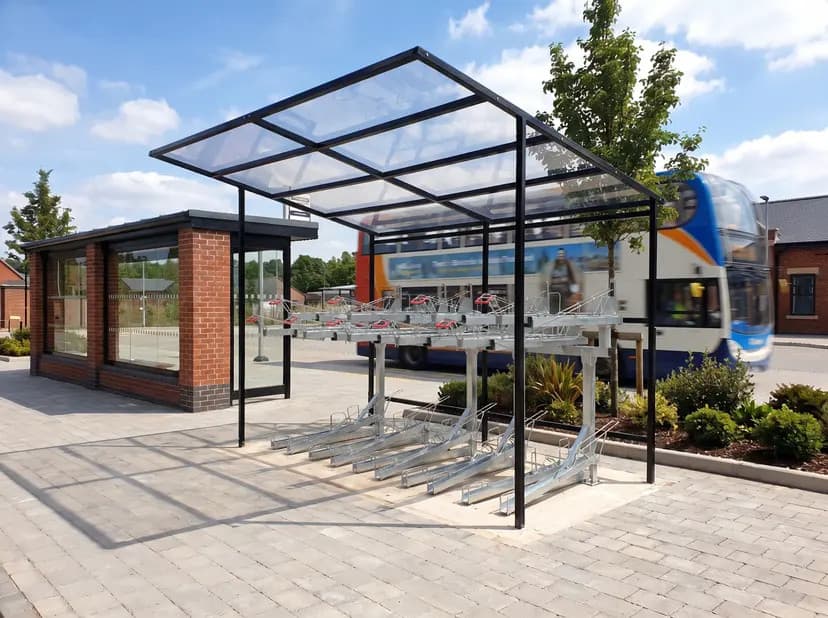
How Sheltered Two-Tier Bike Racks Make Cities More Cycle-Friendly
25 September 2026
A city can say it wants more people to cycle. It can paint the bike lanes, install the signs and publish the glossy transport strategies. But a less glamorous question often gets overlooked: where are all those bicycles supposed to go when they're not being peddled?
A city can say it wants more people to cycle. It can paint the bike lanes, install the signs and publish the glossy transport strategies. But a less glamorous question often gets overlooked: where are all those bicycles supposed to go when they're not being peddled?
As cycling becomes a more important part of urban transport, bike parking is moving from an afterthought to a piece of city infrastructure. That shift matters. A convenient, secure place to leave a bicycle can be the difference between cycling to work and deciding that taking the car is simply easier. This is where sheltered two-tier bike racks offer an invaluable solution.
Making better use of limited space
Making the case for two-tier racks is easy. They are that good. And the best thing about them for developers? How much they optimise your space.
Space is one of the most valuable commodities in cities, especially in central areas which are typically already overbuilt. Pavements already do a lot of heavy lifting. They must accommodate pedestrians, trees, benches, lighting, deliveries, accessibility routes, and public transport. Finding room for hundreds of bicycles can quickly become a design headache.
Two-tier racks tackle the problem by using the vertical dimension. This way, instead of spreading bicycles across a large footprint, the upper and lower parking positions accommodate significantly more bikes in the same area.
This can be particularly useful around railway stations, universities, offices, shopping districts and high-density residential developments. They are all places where demand for cycle parking can be substantial and space limited.
But before you say anything like "Doesn't that sound a bit... cramped?" No. It means compact, and that's a different story. A good two-tier system like ours gives riders enough clearance to manoeuvre their bikes comfortably, with a straightforward lifting or sliding mechanism for the upper level.
A roof changes the equation
Shelter may sound like a minor addition, but it has a surprisingly practical role.
Bicycles left outside are exposed to rain, snow, wind, sunlight- you name it. Over time, those conditions can contribute to rust, fading and general wear, particularly when we are talking about long-term bike parking. That is, bikes parked in the office for 8 hours a day or overnight in a residential building.
A covered facility provides a basic layer of protection and can make cycle parking considerably more pleasant to use. Riders are happy – their bikes are dry and protected. Developers are happy – their bike racks are also dry and protected.
Sheltered parking can also make cycling feel more established and intentional. A dedicated, well-designed facility sends a simple message: bicycles belong here. That matters in places where cycling is still competing with a long-established car culture.
Good design should not look like an afterthought
Urban regeneration projects and town planning these days often involve careful attention to materials, landscaping, lighting and architecture. Cycle parking needs to be considered with the same mindset. People want to live in beautiful areas – it's that simple.
A bulky shelter with unsightly materials can undermine an otherwise carefully designed public space. Conversely, a compact structure with clean lines, durable materials and considered detailing can sit comfortably alongside modern architecture or a refurbished historic setting.
This does not mean every bike shelter needs to become a design statement—quite the opposite. The most successful approach is often understated. Neutral or natural finishes, slim structural elements and a restrained roof profile can help the shelter blend into its surroundings. Transparent or semi-transparent panels can maintain visibility and avoid creating an enclosed, hidden corner. Integrated lighting can improve usability after dark while contributing to a safer-feeling environment.
There is also an opportunity to echo existing architectural details. Materials, colours and forms can be selected to complement nearby buildings, paving or street furniture. In a regeneration scheme, these small decisions can make the difference between infrastructure that feels integrated and infrastructure that feels bolted on.
Security needs to be part of the design
A beautiful shelter is not much use if people are nervous about leaving a valuable bicycle inside it. So, obviously, we need to talk about security. Security should be considered from the beginning rather than added as an accessory. Secure locking points, robust construction, appropriate lighting, and good visibility all play a role. Depending on the location, access-controlled facilities or monitored cycle hubs may also be appropriate.
The best thing about our two-tier racks is that they're secure by design. They offer multiple locking points, are made from high-quality materials that are hard to tamper with, and keep bikes steady and in place with ease.
On top of that, as we said, adding a roof and, we would add here, sides and even gates, is a game-changer for security. Some of our shelters, like the Bristol Two-tier Racks and Shelter model, can be manufactured with security gates with various locking options.
Accessibility matters too
Different cyclists have different levels of strength, height and mobility, so intuitive mechanisms and a sensible allocation of spaces are important. Two-tier parking gives users options. That means they can either wheel their bike onto the bottom tier or choose the top one. The lower spaces are easy to access, and the top tier, although it may look complicated, isn't. Trust us. We know that if using the system feels like operating a piece of industrial machinery, people are unlikely to thank the designer. So we've made sure that's not how our racks work. They have a smart, gas-assisted mechanism designed around real-world use that makes lifting and lowering an easy job.
Lastly, it is also worth considering the variety of bicycles now appearing on city streets. Cargo bikes, adapted cycles, e-bikes and bikes with child seats do not always fit neatly into conventional racks. A thoughtful parking strategy can include a mix of standard and larger spaces rather than assuming every bicycle is the same.
Designing the cycle-friendly city
No single piece of infrastructure will transform a city's cycling culture. Safe routes, sensible traffic planning, good public transport connections and secure parking all matter. And so does the bike rack.
Sheltered two-tier systems combine practical capacity with an opportunity for thoughtful urban design. They can fit into constrained sites, support higher-density developments and contribute to cleaner, more organised public spaces. With the right materials and proportions, they can even add visual interest to a regeneration project.
Most importantly, they recognise a simple truth: if cities want people to choose bicycles, they need to make the whole journey work. That journey does not end when the rider reaches the destination. It ends when the bicycle has somewhere safe, convenient and sensible to wait until the next trip.
Good cycle parking may not be the most exciting part of an urban regeneration project. It probably will not appear on the cover of an architecture magazine. But when it is designed well, used every day and quietly makes cycling easier for hundreds of people, that is exactly the sort of infrastructure a city should be proud of.
