When planning a new development, one challenge is figuring out how much bike parking you’ll actually need. The thing about an existing site is that, as silly as it sounds, you can’t simply stand outside and count how many people arrive by bike. But with new developments, there are no commuters to jot down, no residents to survey, and no historical data to analyse.
So how do developers, architects and planners estimate future demand? The answer lies in a combination of planning policy, local context, expected user behaviour, and a little future thinking. And while it might be tempting to provide the bare minimum your local planning authorities are asking for, doing so can often leave developments struggling to meet demand a few years down the line.
Let’s look at how to estimate bike parking demand properly and why two-tier bike racks and shelters can help you future-proof your project.
Start with Local Planning Requirements
Across the UK, cycle parking requirements are generally set by local planning authorities rather than national building regulations. Many councils now treat cycle parking as a key part of sustainable transport planning. This is why the first place to look is your local authority’s cycle parking standards. This should be a giveaway of what you can expect since somebody has already done a general calculation for you based on your type of building.
For example, Buckinghamshire Council requires:
- 1-bedroom homes: storage for 1 bicycle
- 2- and 3-bedroom homes: storage for 2 bicycles
- 4-bedroom homes: storage for 3 bicycles
- 5-bedroom homes: storage for 4 bicycles
- What type of building is it – residential, office, retail, or educational institution?
- How many people will likely use the building daily?
- What kind of bikes do I think they will ride – e-bikes, regular, cargo?
- How long will cyclists typically stay at the location? Overnight, work hours, short-term?
- Is cycling growing in my area, and is that likely to affect the future number of cyclists in my building?
- Am I likely to be actively encouraging cycling?
- Is the area receiving new cycling infrastructure?
- Are there nearby train stations encouraging cycle-to-rail journeys?
- Is the local authority actively promoting active travel?
- Are younger demographics likely to occupy the development?
But as we said, ideally, these guidelines should be your starting point, not your finishing point. Many developers make a wise choice to exceed local requirements because they recognise cycle parking as desirable and quite marketable. Prospective residents increasingly ask about bike storage. Employers want to support sustainable commuting. Investors are paying greater attention to ESG and sustainability credentials. So, going above and beyond the requirements is what will set your building apart.
So, how many bike parking spaces do I need then?
The truth is, there is no simple general formula or known quantities that work for everyone. But you can start by thinking about these questions:
Type of Building and Cyclists
The type of building you have will tell you who goes in and out and how long they stay.
An apartment block? 13% of people in England say they cycle once a week, which is a good figure to use when planning parking spaces. In residential developments like apartment buildings, people need long-term overnight parking and are likely to have no place for bikes inside their small living spaces, so they will need bike parking elsewhere in the building.
An office? You can estimate the number of desks and employees who would use it, and based on general patterns, you will be able to tell that they will need secure all-day parking and would enjoy extra facilities like showers and lockers. In England, only about 4% of people commute to work by bike, so what would that look like in a 300-person office? 300 employees and an estimated 4% cycling rate would mean a potential daily bike demand of 12 bicycles. However, places like London have seen huge increases in cycling up to 1.5 million journeys a day, so if your office of 300 people is in London, you’d probably want to double up your numbers to be on the safe side.
A student library? Both long- and short-term parking would be ideal, and you should plan for more cyclists, as bikes are a cheap mode of transport often preferred by students. Some places, like York, report that up to 20% of students cycle to university, and cities like Cambridge say 50%.
The bottom line is that different developments generate very different cycling patterns.
Local Context
Don’t make the mistake of assuming current cycling levels will remain unchanged throughout the lifetime of a building. Local authorities across the UK are investing heavily in active travel infrastructure. New cycle lanes, low-traffic neighbourhoods, cycle-to-work schemes and improved public transport integration are all making cycling a more attractive option.
The context of your local area and any future plans the local council might have about expanding cycling infrastructure should also tell you if cycling is likely to go up. The general rule is that with better bike lanes come more cyclists, and the numbers quoted above for London are a case in point. When estimating demand, it is worth asking:
Your Own Plans
The last question is about your intentions. Are you going to build it and have them come, or will you actively encourage your occupants to cycle more? If you are planning to passively satisfy demand and leave it at that, then you can do the minimum plus a few on top to be covered and be done.
But if you are going to encourage people to bike by promoting cycling initiatives, joining a bike-to-work scheme, setting up a bike buddy system or bike maintenance workshops, then you need to factor that in. If you offer people well-designed end-of-trip facilities and secure bike parking plus active encouragement, you may quickly find that you are speedily flying past the nation’s averages of cycling percentages and therefore needing more racks.
Why Two-Tier Bike Racks and Shelters Make Sense
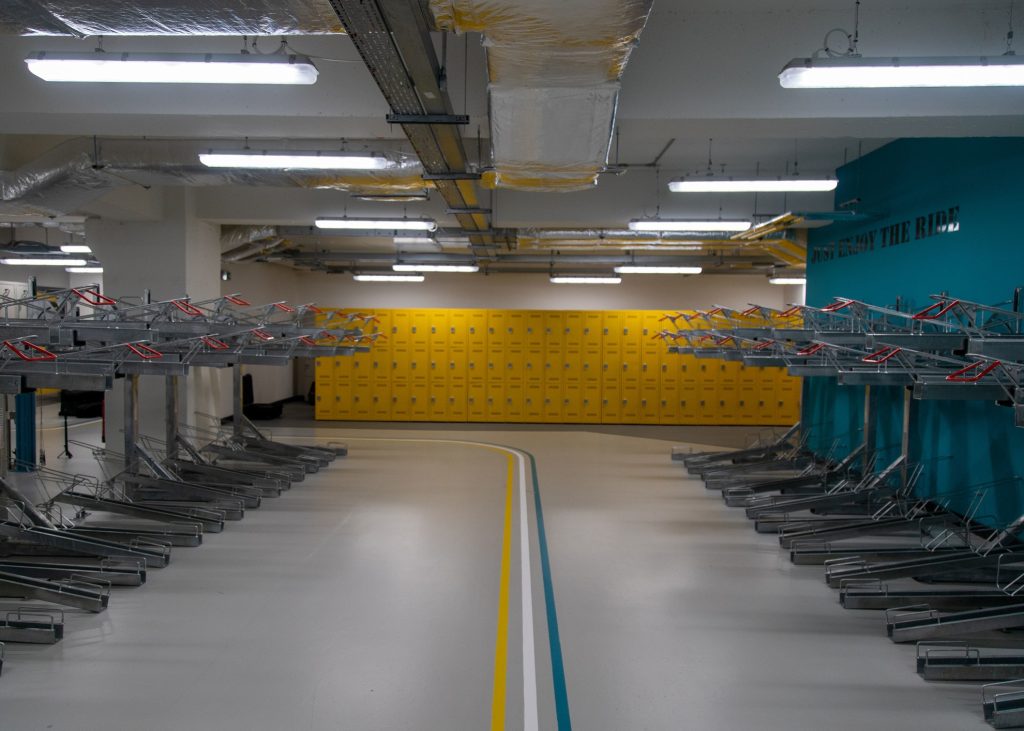
Once you’ve estimated demand, the next challenge is finding enough space. This is where two-tier bike racks become invaluable. Rather than spreading bikes across a large footprint, two-tier systems make use of vertical space, effectively doubling storage capacity within the same area.
They also mean easier future expansion since two-tier systems can be extended as demand grows, making them ideal for phased developments or sites where future uptake is uncertain.
Another plus is that two-tier racks are secure, safe, and easy to use, making them a winner with both local authority cycle parking requirements and users.
And all this talk about capacity is important, but so is usability and comfort. If your racks are indoors, that is fantastic, but if they are outside, you should be thinking about adding a shelter. A bike storage area that leaves bikes exposed to the British weather is less attractive than one that provides proper protection.
Covered two-tier bike shelters protect bikes from rain and UV exposure, increasing the security of the facility and showing you really care about cyclists and their property. Besides, Many local authorities also expect cycle parking to be secure, accessible and covered wherever possible. Surrey County Councill, for example, recommends cycle parking that is undercover, secure, well-lit and located close to its destination.
Estimating bike parking demand for a new development isn’t an exact science, but it doesn’t have to be guesswork either. By combining local planning requirements, demographic insights, active travel trends and future growth projections, developers can take out a lot of the guesswork. And when space is limited, as it often is, two-tier bike racks and shelters provide one of the smartest solutions available. They maximise capacity, support planning compliance, improve the user experience and help future-proof developments for a world where cycling plays an increasingly important role in how we travel. The best cycle parking isn’t just enough for opening day, it’s enough for the years ahead.
