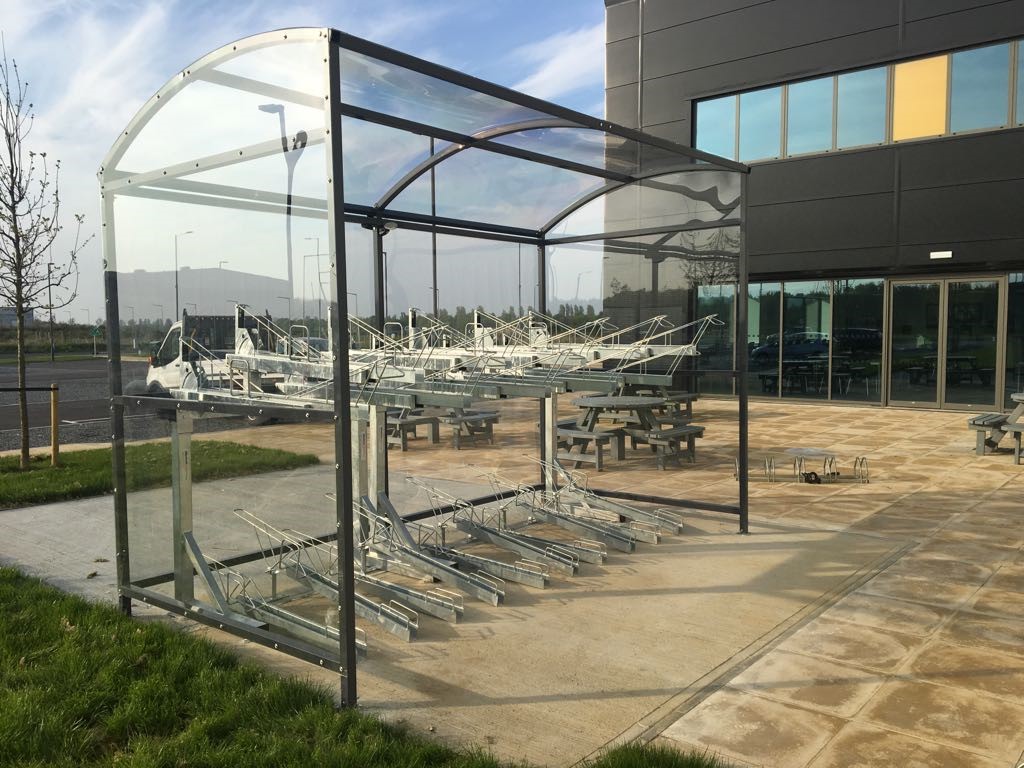
Great cycle parking can encourage more people to travel by bike. Poor cycle parking? It can have the opposite effect. Whether you’re designing a workplace, residential development, school, transport hub or public space, it’s easy to focus on the number of bike spaces required and overlook the finer details that make a cycle parking area practical and usable.
The good news is that most common mistakes are easy to avoid with a little planning. Here are eight of the biggest pitfalls we see, and how to make sure your cycle parking works for the people using it.
Underestimating How Much Cycle Parking You’ll Need
One of the rookie mistakes is simply not providing enough spaces. We see this often with developments which throw a few spots to appease the local authorities but don’t really put their heart into it. That’s a box-ticking exercise, and you can often tell because the 10 spots fill up at 8:30, and you either see cyclists chaining their bikes to lampposts, despite the cycle parking area, or fewer people cycling overall because it’s become too much of a bother.
The other catch here is the future. Now, we are not saying we can see the future, but it sure looks like the government and local councils are increasingly embracing active travel. That means more money and more infrastructure. That, in turn, means more cyclists on the roads and, probably, in an office near you very soon. As cycling grows, demand for cycling parking will too. What feels like “plenty” of parking today could be full within a few years. And retrofitting extra cycle parking later can be expensive and disruptive, so it’s worth thinking ahead from the start.
Two-tier bike racks are perfect for this because you really get a two-for-one deal. In the same space where you could have installed another rack to make the council happy, you could be providing two bike parking spaces.
Choosing the Wrong Type of Bike Rack
Not all cycle parking is created equal. We are not out to insult good old Sheffield stands, they are still an excellent option for many places, but they aren’t always the best solution for higher-capacity projects.
If you’re trying to accommodate dozens or even hundreds of bikes, standard racks can quickly eat up valuable floor space. Modern two-tier systems offer a much more efficient layout while remaining user-friendly. They’re particularly well-suited to large offices, residential developments, universities, and transport and public cycle hubs. The key is choosing a solution that fits both your available space and expected demand.
Forgetting About Shelter
Imagine arriving at work after cycling through a typical British downpour. Comfortable? No. Refreshing? Maybe. Making you wish you had a nice dry place to park your bike? Yes. You’d probably appreciate knowing your bike won’t spend the next eight hours sitting in the rain.
Unfortunately, uncovered cycle parking is still surprisingly common. We always urge clients, if you can afford to in both space and budget, to install a bike shelter; it’s a must. Shelters protect bikes from the weather, prolong the lifespan of the racks themselves, keep the parking area looking smarter, and give cyclists confidence that their bikes are being stored somewhere secure and well-maintained.
Two-tier bike shelters are especially effective because they combine high-capacity storage with weather protection. Depending on the project, they can be specified with polycarbonate roofs, side and rear panels, gated access and even integrated lighting to create a safe, welcoming space for cyclists.
Ignoring Lighting and Security
People are far less likely to use cycle parking if it feels unsafe. Dark alleys and dark corners, hidden locations and poor visibility do not sound reassuring, do they? Installing your racks in a place like that can discourage cycling, particularly during winter months when many commuters are travelling in the dark.
Good cycle parking should feel secure as well as being secure. Simple additions can make a huge difference. Some of our bike shelter models, like the Bristol two-tier bike shelter, come with LED lighting and lockable gates precisely because of that. You can also go an extra mile and add CCTV. Also, as a good rule of thumb, you should place your bike parking close to entrances and exits, where there is more natural surveillance, foot traffic, and well-lit pedestrian routes.
Poor Positioning
The best bike racks in the world won’t get much use if nobody can find them. As we said above – dark alleys and away from entrances, that’s not the best idea. We’ve all also seen cycle parking tucked behind bins, hidden around the back of buildings or placed in awkward service yards. And like with every service or product, convenience matters.
Ideally, cycle parking should be close to the main entrance, easy to locate, well-signed, accessible free of unnecessary detours, and connected to existing walking and cycling routes. The easier you make it to park a bike, the more likely people are to choose cycling in the first place.
Forgetting About User Experience
Cycle parking should be easy to use. That sounds obvious, but it’s often overlooked during the design process. Think about how someone actually arrives by bike. Can they comfortably manoeuvre into the space? Is there enough room between rows? Can different bike types be accommodated? Can someone easily use the bike racks?
Design the space so that all of the above are answered with “yes”. Features like gas-assisted lifting mechanisms on our racks significantly reduce the effort required to load bikes onto the upper level, making them practical for everyday use rather than something cyclists try to avoid, and guaranteeing that the answer to that last question is a “yes” too.
Not Future-Proofing for E-Bikes
E-bikes are no longer a niche mode of transport, nor a curiosity on the streets. They’re becoming an increasingly common sight on UK roads, particularly for commuting and longer journeys. That means cycle parking needs to evolve too. E-bike users may need more secure parking, robust racks, extra space, and charging facilities. Forward-thinking developments are already planning for this shift.
Dedicated electric two-tier racks, like ours, with integrated charging points are now available, allowing cyclists to securely park and charge their bikes at the same time. It’s a relatively simple addition that can help future-proof your development as e-bike ownership continues to grow.
Good Cycle Parking Is About More Than Bike Storage
Well-designed cycle parking isn’t just somewhere to leave a bike. It’s part of the overall journey. When cyclists arrive at a location that feels safe, convenient, and thoughtfully designed, it reinforces the decision to travel actively. On the other hand, poor facilities can quickly undo the benefits of nearby cycle lanes or active travel investment. For developers, employers and local authorities alike, investing in high-quality cycle parking can support sustainability goals, improve user experience and make developments more attractive to residents, staff and visitors.
Whether that’s installing space-saving two-tier bike racks inside a building or creating a fully covered cycle hub with two-tier bike shelters, the right solution depends on understanding how people will actually use the space. A little extra thought during the design stage can make a big difference for years to come and help create cycle parking that people genuinely want to use.
