If you’ve owned a bike, you’ve likely had it stolen or worried it might be. Every cyclist knows security is the top concern when parking. No matter how modern the building or impressive the landscaping, if bike parking feels flimsy or awkward, people won’t trust it. Why? Because it feels insecure. When the confidence in its security is lacking, people also won’t use it, defeating the whole purpose of installing it.
And here’s the thing — “secure” means more than just having somewhere to attach a lock. To be truly secure, bike parking needs to offer more than the alternative street lamp post. Locking your wheel or just the frame is not enough. A superior rack would allow for the frame and wheel to be chained simultaneously. It would also be easy to use and work every single time. If these conditions are not fulfilled…well, the rack isn’t really doing the best job it could.
So if you’re specifying bike parking — whether for a commercial site, residential development, school or station — it’s worth understanding what genuinely secure design looks like.
Why Frame Locking Alone Isn’t Enough
You’ve probably seen it before. A bike locked neatly by the front wheel… and nothing else. You’ve probably also seen the consequences of that – a chained solo wheel hanging where a whole bike used to be. The problem? Quick-release wheels exist as well as thieves with nimble hands.
If a rack secures only a wheel, a thief can remove it in seconds and take the rest of the bike. Many stands still don’t support proper frame locking and the frame is the most valuable part of the bike. It’s also the hardest part to replace. So any secure rack must allow the cyclist to attach their lock through the frame, ideally along with at least one wheel. This way makes it quite a bit harder for any thief to walk away with their bike or significant parts of it.
What a Proper Locking Point Looks Like
A secure rack should have a locking bar or hoop close to the bike frame so a D-lock or chain fits easily.
There are a few things that matter here. The locking point should ideally be made of solid steel. It should be firmly fixed to the main structure. It shouldn’t wobble or flex. And it should sit at a practical height — not too low, not too high. If users must crouch, stretch, or thread a lock through tight gaps, it’s a design flaw. Good cycle parking should make locking intuitive. If it doesn’t secure the bike comfortably and naturally, cyclists will struggle to use it or avoid it altogether.
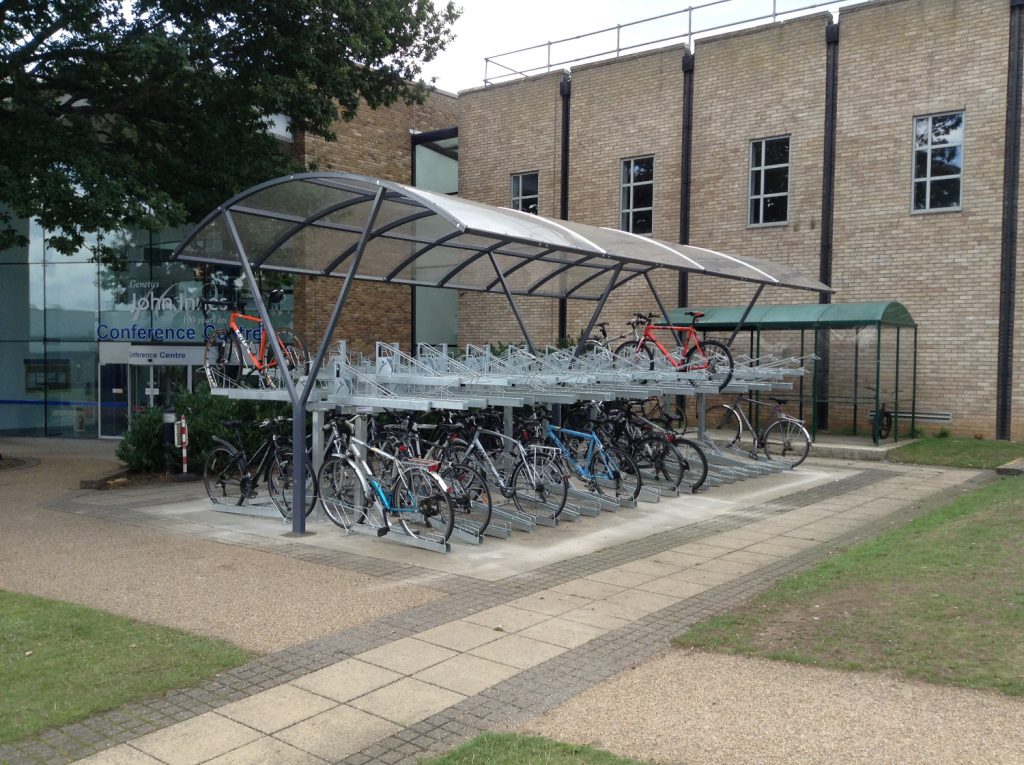
In two-tier rack, especially, integrated locking bars are essential. The bike should sit securely in a wheel channel while the rider locks both frame and wheel without having to steady the bike with one hand.
Material Strength Matters
Security isn’t just about design. It is also about material quality. Locking bars and structural components should be made from heavy-duty steel, ideally hot-dip galvanised to resist corrosion. Over time, rust weakens metal, and weakened metal is easier to damage or tamper with. If a locking bar bends easily or shows signs of corrosion within a few years, it becomes a vulnerability.
Galvanised finishes protect the structure long-term. Powder coating can add weather resistance and improve appearance. But what matters most is the strength underneath. A secure rack should feel solid and not rattle when grabbed.
Our Racks and the Real World
Strong materials and solid locking bars are essential, but security isn’t tested in a showroom. It’s tested on a wet Tuesday morning when commuters are in a rush, students are squeezing into tight spaces, and dozens of bikes are being parked within minutes. That’s the real world.
In busy environments like train stations, office buildings, universities or residential blocks, cycle racks don’t get treated gently. They’re used constantly. Different bike types, different lock styles, different levels of experience, all interacting with the same structure every single day. A secure rack needs to cope with that kind of daily pressure.
Spacing plays a bigger role than many people realise. If bikes are crammed too tightly together, handlebars clash, pedals overlap, and locking becomes awkward. When that happens, cyclists may rush the process or settle for securing only part of the bike properly. Neither is ideal.
Well-designed two-tier systems strike a balance. They maintain compact centre-to-centre spacing to maximise capacity, but still allow enough room for riders to manoeuvre comfortably and lock through the frame without contorting themselves.
It’s also important that the rack accommodates a range of bike styles, from slim road bikes to wider mountain bikes. If a cyclist has to wrestle their bike into position before they’ve even started locking it, that frustration chips away at the sense of security the facility is meant to provide.
In short, real-world security isn’t just about preventing theft. It’s about making secure locking simple, repeatable and reliable — even when the area is busy, and people are in a hurry. When a rack performs well under everyday pressure, that’s when you know it’s genuinely secure.
The Role of Shelters and Surroundings
Even the best rack can feel insecure if it’s placed in a dark, out-of-sight corner. Security works best when there are multiple layers. Ideally, racks should be in easily accessible, well-lit locations that are visible from nearby buildings or footpaths.
If your space and location allow, you should also install a shelter. A shelter adds more than weather protection. It creates a defined, organised parking zone which signals that cycling is supported and considered. But it can also be installed with gates and locks to up your bike storage’s safety and security game.
Finally…It All Comes Down to Confidence
At the end of the day, secure bike parking often comes down to confidence. When someone cycles to work, a train station, or home, they trust the parking space. They need to know their bike will still be there, safe and undamaged, when they return.
That confidence is built through thoughtful design. It starts with a rack that lets the bike rest securely in a stable wheel channel. The rack should keep it upright and supported while it’s locked. It must let the user pass a D-lock through both frame and wheel, securing the key parts to a solid, immovable bar. The environment matters too — it should feel visible, well-lit, organised, and clearly designed with care.
Frame and wheel locking isn’t a minor detail. It makes the difference between cycle parking that only looks good and parking that works in real life. A secure rack allows proper locking without awkward angles or guesswork. It keeps the bike steady and is built from strong, corrosion-resistant materials. It should be spaced right, firmly installed, and feel solid when leaned on.
When all these parts come together, two-tier racks do more than save space. They become a dependable infrastructure that cyclists can rely on every day. That’s what matters. The best cycle parking isn’t just the one that fits the most bikes. It’s the one people trust enough to use again and again, without hesitation.
