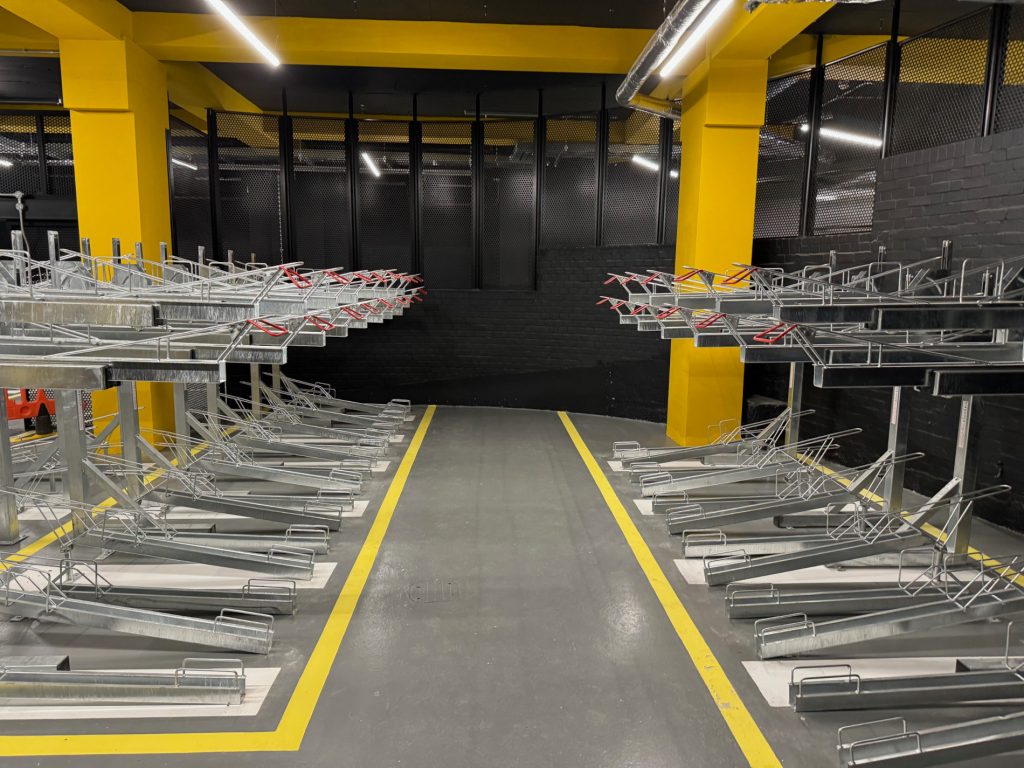
When it comes to installing cycle parking, the two S words – security and safety- are what come up at the top of worries. And rightly so. Security, we cover here, but let’s talk about safety. Property managers, developers, schools, transport operators and business owners all tend to ask the same questions. Can bikes fall from the upper tier? Is there a risk of injury when lifting? Are two-tier racks compliant with health and safety standards? Will the system still perform safely years down the line?
These are all totally valid and important questions — and the good news is that a well-designed two-tier bike rack system is extremely safe when specified and installed correctly. Let’s break down what actually makes cycle parking safe, stable and secure.
Stability Starts with Strong Construction
The foundation of safe cycle parking is robust structural design. A poorly constructed rack can flex, weaken or corrode over time. That is the reason why our products are manufactured from high-quality heavy-duty steel, and typically hot-dip galvanised to BS EN ISO 1461. Plus, for our upper tier, we use stainless steel bearings for long life and minimum maintenance.
These attributes give our racks long-term corrosion resistance and a solid build, maintaining structural integrity over years of use. Our racks remain stable even in high-traffic environments such as busy transport hubs, educational institutions, offices, and residential developments.
Wheel Channels – The Unsung Safety Feature
One of the most important, and often overlooked, elements of safe cycle storage is the wheel channel design. In a properly designed two-tier rack, the bicycle sits securely within a formed steel wheel channel. The channel stops any sideways movement and supports the bike along its length. This means the bicycle doesn’t hang awkwardly or rely on a single contact point. Instead, it’s well supported and balanced, significantly reducing the risk of tipping.
On the lower tier, sloping wheel channels are not to be shrugged at either. They allow users to roll the bike into place naturally without bending. And if that doesn’t sound like improved comfort and safety, we don’t know what does.
Gas-Assisted Lifting
One of the biggest misconceptions about two-tier racks is that they require heavy lifting. This couldn’t be further from the truth about our two-tier racks.
Modern systems, like our designs, use gas-assisted struts to counterbalance the bike’s weight. This means the levels of strain and risk are pretty low. Upper trays lower smoothly to ground level. Bikes are loaded at a comfortable height. Minimal force is required to raise it back into position. Sounds pretty effortless, right?
The mechanism is designed in line with health and safety principles, ensuring that lifting is controlled and manageable for the average user. Plus, we use stainless steel bearings, which means movement remains smooth over time, reducing stiffness and preventing jerky operation — another bonus for safety.
Space Planning Matters
Even the safest rack can become problematic if poorly laid out. When planning, keep in mind that you need to provide adequate space on top and the sides.
With higher racks like the two-tiers, minimum ceiling height is an important metric. Typically, around 2400mm is enough for problem-free loading. You also need adequate depth clearance and sufficient aisle width, usually at least 1500mm entrance space, so people don’t bump into each other’s bikes.
Good spacing ensures users can move freely, operate upper tiers comfortably, and avoid silly accidents.
Maintenance: The Hidden Safety Factor
The road to safe exploitation isn’t full of some mysterious rack hacks. It’s all down to the few simple but essential things we covered above and regular check-ups. Even the best-designed rack requires periodic inspection.
Routine checks should include ensuring that gas struts and all other moving parts operate smoothly. You should also make certain that fixings and anchors are always well fixed to the ground, and there hasn’t been any damage that you haven’t noticed. Regular inspections for corrosion or damage are also a great idea because small problems caught early usually require small fixes, unlike bigger problems caught too late. Lastly, to keep your users’ bikes safe and secure, you should check the locking bars for any damage.
Fortunately, galvanised systems and stainless steel components are designed for minimal maintenance. They work smarter, not just harder, particularly in outdoor or high-use environments. However, this isn’t a license to ignore maintenance. Being proactive prevents tiny issues from becoming safety risks.
So, In A Nutshell
This was a lot of words, so TL;DR let’s answer those original questions in less:
Can bikes fall from the upper tier?
Not when properly loaded into the wheel channel and secured. The tray design supports the bike along its length and keeps it stable. This makes the upper-tier bikes just as stable as the lower-tier stored ones.
Is there a risk of injury when lifting?
Gas-assisted mechanisms, which we use, significantly reduce the lifting force. The lift is effortless, and any well-designed system will give you controlled and smooth operation.
Are two-tier racks safe in busy environments?
Yes — when installed with proper spacing, robust materials, and secure anchoring.
The Bigger Picture
Why does it matter so much that bike racks are safe? Safe cycle parking does more than prevent accidents. It builds confidence. When cyclists feel their bike is secure, stable, and easy to store, they are far more likely to commute by bike to your workplace and choose cycling over driving. People are also more likely to use cycle-to-rail facilities and give recommendations to others. Poorly designed storage discourages cycling and active travel. Safe, well-engineered systems actively promote it.
Designing safe cycle parking isn’t complicated. But it does require attention to detail, and it should be done right from the beginning. Starting with a good, high-quality rack that ticks the boxes for robust construction, gas-assisted lift, secure locking points, and channels. Then make sure you don’t ruin a good rack with poor placement, and plan for proper spacing and installation.
When these elements come together, two-tier bike racks are not only space-efficient but also stable, reliable, and safe for daily use. And in a world increasingly focused on active travel, providing safe cycle parking isn’t just good practice. It’s essential infrastructure.
