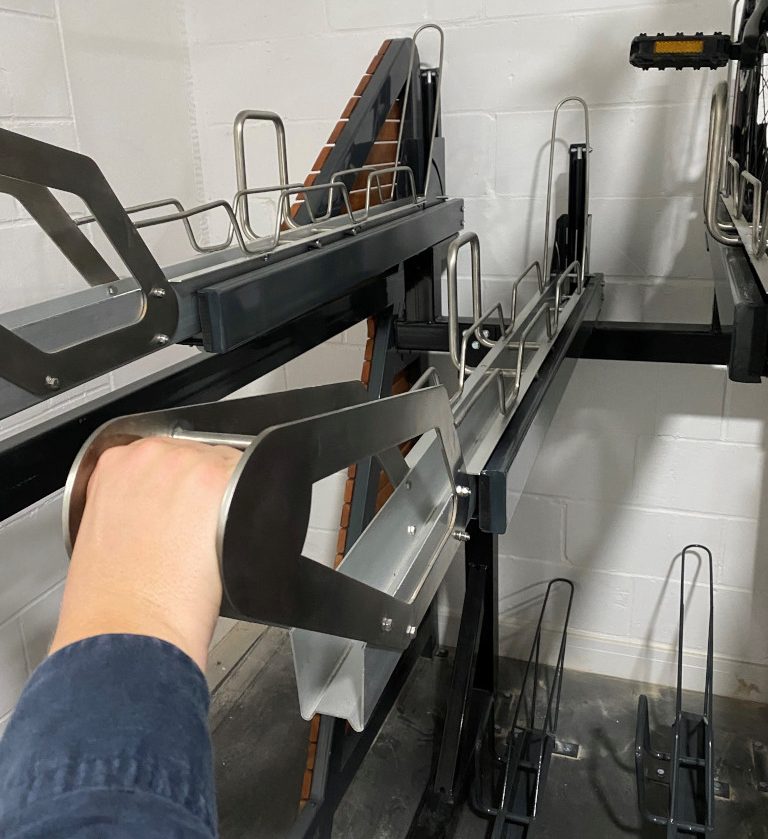
When specifying two-tier bike racks, it’s easy to focus on the visible features — the frame, the finish, the shelter, the capacity. But there’s one small detail that rarely gets asked about — and yet it plays a huge role in how the system performs over time: the bearings inside the upper-tier mechanism.
They’re not visible, and they rarely make it in marketing photos. But if you’ve ever used a two-tier rack that feels stiff, jerky or awkward, chances are the bearings are part of the problem. Let’s talk about why stainless steel bearings genuinely matter.
First, What Do Bearings Actually Do?
In a two-tier system, the upper rack slides forward and down to allow the user to load their bike at ground level. Bearings are components that allow the bike tray to slide smoothly and consistently under load and in daily use.
Every time someone pulls the tray out, pushes it back, or raises it into place, those bearings are doing the work behind the scenes. In a busy station or office block, that could mean dozens of movements per day. You can imagine how much strain that creates over months and years. That’s a lot of wear for any mechanism, which is why material choice is critical.
If the bearings are of poor quality, the entire system will eventually feel heavy, uneven, or unreliable. And once that happens, people start avoiding the upper tier.
Smooth Operation = Better User Experience
One of the biggest concerns people have about two-tier racks is usability. If the upper tray feels stiff, jerky or difficult to pull out, users may avoid it altogether. That can lead to overcrowding on lower tiers and underused upper levels.
With stainless steel bearings, the tray glides. It doesn’t grind. It doesn’t catch. It doesn’t require a tug and a second attempt. The movement feels controlled and smooth; there is more comfort, less friction, and less effort.
When combined with gas-assisted lifting, they make the upper tier feel light and easy to use, even for less confident cyclists.
A smooth mechanism isn’t just a luxury. It’s what keeps the system practical and usable day after day.
Why Stainless Steel Specifically?
Cycle storage isn’t usually installed in cosy, climate-controlled environments. It’s often found in outdoor shelters, underground car parks, coastal areas and exposed public spaces. These are damp, high-traffic environments. Moisture, dirt and temperature changes are part of daily life.
Standard steel bearings are vulnerable to corrosion. Once rust develops, friction increases. Movement becomes rough. Over time, the tray may begin to stick or slide poorly. Stainless steel is far more corrosion-resistant. It handles moisture better. It tolerates environmental exposure without degrading at the same rate. That means the sliding mechanism continues to perform the way it did on day one, even years later.
Lower Maintenance, Longer Lifespan
If you manage a building or transport hub, you’ll know that maintenance budgets matter and maintenance is a major consideration.
A system with inferior bearings may require more frequent lubrication and component replacements. Over time, trays may jam, prompting user complaints and potentially requiring staff intervention and downtime if repairs are needed.
Stainless steel bearings significantly reduce that risk. They’re designed for longevity. They cope better with heavy daily use. And they require less intervention to keep working properly. In practical terms, that means fewer complaints and fewer repair visits.
In high-traffic sites like train stations or universities, this durability becomes even more important.
Safety and Control
When people talk about safety in cycle parking, they usually mean structural stability. Will the rack tip? Will the bike fall? That’s important, of course. But operational safety matters just as much, and high-quality bearings directly affect that.
If a sliding tray sticks or moves unpredictably, it increases the risk of sudden jolts and uncontrolled movement. This can also lead to strain during operation and overall user frustration. High-quality stainless steel bearings contribute to controlled, predictable motion. The tray moves when you expect it to. It stops when you stop. That supports safer operation, especially when paired with gas struts that assist lifting.
The predictability also reduces strain and helps users feel confident operating the system, particularly those who may already feel unsure about using the upper tier. Consistency in movement builds user confidence, and confident users are less likely to misuse the equipment.
The Long-Term View
Two-tier racks aren’t short-term purchases. They’re a long-term infrastructure investment. When a developer installs cycle parking in a residential block, or a council upgrades a station, they expect it to last. Not for a year or two but for decades.
Frames can be galvanised. Finishes can be powder-coated. Gas struts can assist in lifting. But if the internal mechanism degrades, the system becomes impractical. Stainless steel bearings help protect that long-term investment.
When you choose racks with stainless steel bearings, you’re investing in a system designed to perform for years, not just months. Bearings may be a small component in the overall structure, but they directly affect how the system feels and functions every single day. They’re part of what ensures the system remains easy to use, reliable in all weather, and low-maintenance.
The Hidden Detail That Makes a Big Difference
At first glance, all two-tier racks can look similar. Steel frame. Wheel channels. Locking bars. Shelter above. But over time, the quality of the internal components becomes obvious.
Bearings might seem like a minor specification detail. Yet they influence everything from the daily usability, maintenance frequency and safety to user satisfaction and long-term reliability. In high-use environments, especially, those factors add up.
When specifying two-tier bike storage for commercial or public environments, it’s worth looking beyond surface features and asking about the mechanism inside. Because sometimes, the smallest details have the biggest impact.
A Question Worth Asking
Two-tier systems are a smart way to maximise space and support active travel. But their success depends on more than capacity numbers. They need to work smoothly – every day, for every user. If you’re specifying two-tier bike racks for a project, it’s worth asking what bearings are used in the sliding mechanism.
It’s not always the first thing listed on a brochure. But it tells you something about how the system has been engineered. Choosing racks with stainless steel bearings isn’t about overengineering. It’s about understanding where wear happens and addressing it before it becomes a problem.
Stainless steel bearings are hidden but vital. They resist corrosion, cut friction, lower maintenance, and keep the upper tier as usable as the lower one. In other words, they help the system do what it was designed to do — quietly, reliably, and without fuss.
