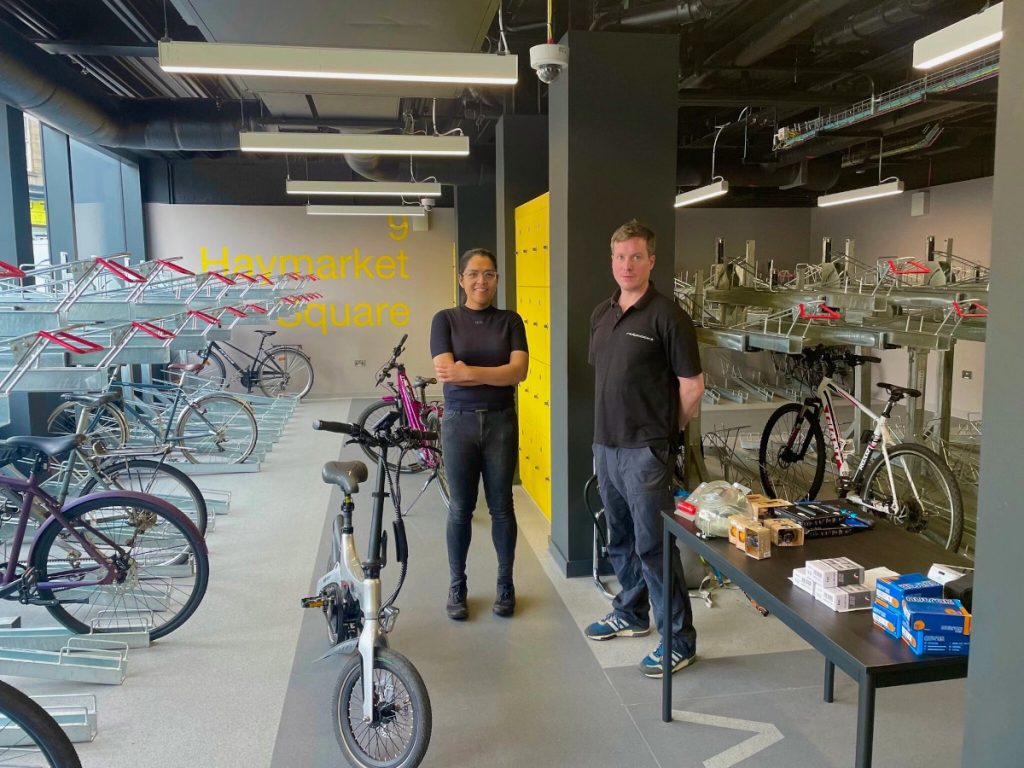
Demand for secure, space-efficient bike storage is rising in the UK. Property developers, facilities managers, architects, and business owners are eyeing up two-tier bike racks as a potential solution. They’re increasingly common in offices, train stations, residential developments, and campuses, but they raise many questions.
We have answered some of them in one of our old blogs, but we thought it’s time for another round. Here, we answer a few more of the most commonly asked questions about two-tier bike racks, helping you decide whether they’re the right choice for your site.
Are Two-Tier Bike Racks Easy to Use?
This is probably one of the top most common concerns when we talk about two-tier bike racks. Understandably so. They look nothing like traditional bike racks and stands, which can make people feel a bit intimidated. To make it worse, some older or less advanced models can be heavy and awkward.
However, modern two-tier racks, like ours, are designed with user comfort in mind. The key thing that sets them miles apart from anything else is the gas strut. The single most ingenious thing about their design is that little lever, which reduces the lifting effort required to almost nothing, and the upper tray pulls down to a convenient loading height with minimal force.
The user simply needs to:
- 1.Pull down the upper tray
- 2.Roll the bike into the wheel channel
- 3.Secure it
- 4.Gently push the tray back up and leave the assisted support to do its magic
Do You Need to Be Strong to Use the Top Tier?
This ties to the first question and its answer. And you may have guessed the answer here is no. You absolutely do not need to be strong to use a bike rack like ours with two levels, as it is very easy.
Quality two-tier racks are designed to comply with health and safety standards, featuring assisted-lifting mechanisms that significantly reduce strain. The required lifting force is far less than the bike’s full weight.
That said, the best thing about two-tier bike racks is exactly that – two levels, two choices. For anyone finding the idea of pushing the bike up and hanging in there, there is always the ground-level tier.
Are Two-Tier Bike Racks Secure?
Security is a major factor in encouraging cycling. If riders don’t feel confident leaving their bike, they simply won’t use the facility. This is why whenever we talk about our racks, we go on so much about security and how many boxes our products tick in that regard.
High-quality two-tier systems typically allow both the frame and the wheel to be locked, use chains or D-locks, and can be easily integrated into secure shelters. When combined with lighting, CCTV, and good visibility, two-tier racks provide a very secure storage solution.
Importantly, the site’s overall design greatly affects security—not just the rack. Consider the full context for best results.
What Finish Is Best: Galvanised or Powder-Coated?
The right finish depends largely on the location and aesthetic requirements of your site.
Hot-dip galvanised steel offers excellent corrosion resistance and is particularly suitable for outdoor or exposed environments. It’s robust, low maintenance, and designed for long-term durability.
Powder coating provides additional visual appeal and allows the racks to match brand colours or architectural schemes. Non-moving parts can be finished in a wide range of RAL colours for a more polished look.
But with our products, for the most part, you don’t have to choose, and you can have both. You can order your bike racks to be made of galvanised steel and have them powder-coated.
What Ceiling Height Is Required for Two-Tier Bike Racks?
This is a crucial question that’s often missed during early design stages.
Two-tier racks require sufficient vertical clearance to operate safely and comfortably. As a general guideline, a minimum internal height of around 2400mm is required.
This allows for comfortable use, safe lifting and lowering of the upper tray and adequate clearance for handlebars and saddles. The ceiling height is particularly important in any retrofits, basement car parks and storage areas that are getting converted into bike parking.
Checking vertical clearance early can prevent costly redesigns later in the project.
Do They Meet Planning and Sustainability Requirements?
In the UK, two-tier cycle racks generally meet planning and sustainability requirements, provided they follow local authority standards.
They are widely accepted for residential and workplace long-stay parking because they maximise capacity within limited space. However, councils might have local requirements like adequate aisle width, sufficient ceiling height, safe lifting mechanisms, and a proportion of ground-level and accessible spaces, including provision for larger or adapted cycles. Always consult relevant area legislation to be sure.
From a sustainability perspective, they support active travel and can contribute to targets and certifications such as BREEAM. Compliance ultimately depends on meeting the specific standards set by the relevant local planning authority.
For developers and planners, this makes them an attractive option during the design phase.
Can Two-Tier Bike Racks Be Extended?
Most systems are modular, meaning they can be extended as demand grows. They can also be installed single- or double-sided and integrated into larger shelter structures.
This flexibility makes them ideal for phased developments or sites expecting future growth in cycling numbers.
Are They Cost-Effective?
While the initial investment is typically higher than basic single-level stands, the long-term value is significant.
Two-tier racks:
- – Maximise space efficiency
- – Reduce the need for additional land
- – Support planning approvals
- – Increase the attractiveness of a site
When you calculate cost per bike space rather than cost per rack, it often represents the most economical solution, especially in the long term.
Can Two-Tier Bike Racks Be Installed Retrospectively?
Yes — and they often are.
While two-tier racks are commonly specified at the design stage of new developments, they can also be successfully installed in existing buildings and car parks. This makes them particularly useful for any refurbs and building upgrades or places needing to quickly add capacity.
Just remember the key considerations for retrofitting, like:
- – Adequate ceiling height
- – Floor condition and load-bearing capacity
- – Access routes for manoeuvring bikes
- – Lighting and visibility
Because two-tier systems maximise storage within the same footprint, they’re often the most practical way to increase capacity without structural expansion.
Do Cyclists Actually Like Them?
The honest answer? They like good ones.
Poorly designed or heavy systems can lead to frustration. Our gas-assisted two-tier racks are loved across workplaces, residential developments and train stations.
Ease of use, security and good layout design make all the difference.
When installed properly within a well-lit, sheltered area, they are seen as a premium cycle parking solution.
So, Are Two-Tier Bike Racks Right for Your Site?
Two-tier bike racks have become a cornerstone of modern cycle infrastructure — and for good reason. They provide high-capacity storage while using space efficiently. They are as secure as racks go and don’t ask for much maintenance. For developments where land is limited, but cycling demand is growing, they offer a practical, future-proof solution.
As active travel continues to rise across the UK, investing in well-designed two-tier cycle storage isn’t just about ticking a box — it’s about creating environments that genuinely support sustainable transport.
If you’re considering installing two-tier bike racks and want to ensure you choose the right specification, layout and finish for your site, seeking expert advice early in the design process can make all the difference.
